Showing posts with label Farmers Market. Show all posts

Wednesday, June 26, 2013

California Adventures: National Parks, Beaches, and Mind Blowing Farmers Markets


There is a Disney theme park called California Adventure, which is very fun and feeds my immoderate pride in my state, but it’s like candy compared to the real meal of exploring the land. I’ve been on a few adventures with my family this month, so here’s a quick post to share some of the good stuff:

Yosemite

Our country’s first National Park is, to me, the genuine “happiest place on earth.” Since before she was born, I’ve been waiting to take my daughter there, and it did not disappoint (despite record high temperatures).

Here are a few views from Glacier Point, looking down on Yosemite Valley. Nowadays the overhanging rock (left) is protected  with guard rails, for obvious reasons, but you can find a lot of photos of intrepid Americans like Teddy Roosevelt and John Muir standing atop it, 3,200 feet above the valley floor.


You can hear Vernal Falls from this distance, spilling hugely over its cliff.
Tiny toddler, on the grass behind the Ahwahnee Hotel.


Meeting John Muir himself, his scrappy frame immortalized in bronze in front of a fake backdrop.


The Beach

There are a lot here, but these photos happen to be at Pismo Beach, famous for clams and "shoulda taken that left turn at Albuquerque." Also for very deep beaches with such soft sand (except for the sand crabs), salt water taffy, Splash Cafe clam chowder, and being home-away-from-home for San Joaquin Valley dwellers.


Farmers Market: Avila Valley Barn

Just north of Pismo is a little town called Avila, very tiny but with a wealth of local food culture. My mother had told me about Avila Valley Barn before, but I was unprepared for the all-out gratuitous food splendor:


A picture is worth a thousand words, and these photos say: If you ever get the chance to visit this place, do it!

Whatever you are doing this summer, I hope it is full of delight. Cheers.


Wednesday, March 20, 2013

For the Joy of Local Produce


I’m not a gusher by nature, but my weekly trip to the farmers' market makes me so happy, I have to share a quick post about it. When my little one is snacking on samples of fruit and cheese, and I’m filling the bottom of the stroller with fragrant fresh produce, I feel like I'm in food paradise. 

It reminds me that shopping this way isn't about obligations or guilt or fear or some misplaced self-righteousness -- it's about joy! It's hard to remember my reasons for buying produce anywhere else. 

Here’s this weeks haul from the market:

These Albion strawberries are always on my list. They're not organic, but they were picked less than 20 miles from my house about 2 hours before I bought them, so it's hard to complain. You can smell their sweet summery fragrance from yards away, and when we get close to this stand my daughter points excitedly. They always offer her a sample -- by the time we leave the market she has red juice all over her face and hands, and a big smile. 


Heirloom Mother Beck oranges and fresh, raw almonds from Etheridge Organics in Dinuba. I love getting samples of all the different citrus the farm produces, as well as kiwi and, new this week, dried figs! It's all delicious, but these Mother Becks blew me away -- it somehow tastes exactly like an orange should. 

Kale and and Japanese dandelion greens Underwood Family Farms. My husband surprised me last week by dusting off our juicer and experimenting with random combinations of whatever produce he could find in our fridge -- melon, carrot, spinach and apple was my favorite! He's been asking for kale to try, and these Japanese dandelion greens also looked promising.  
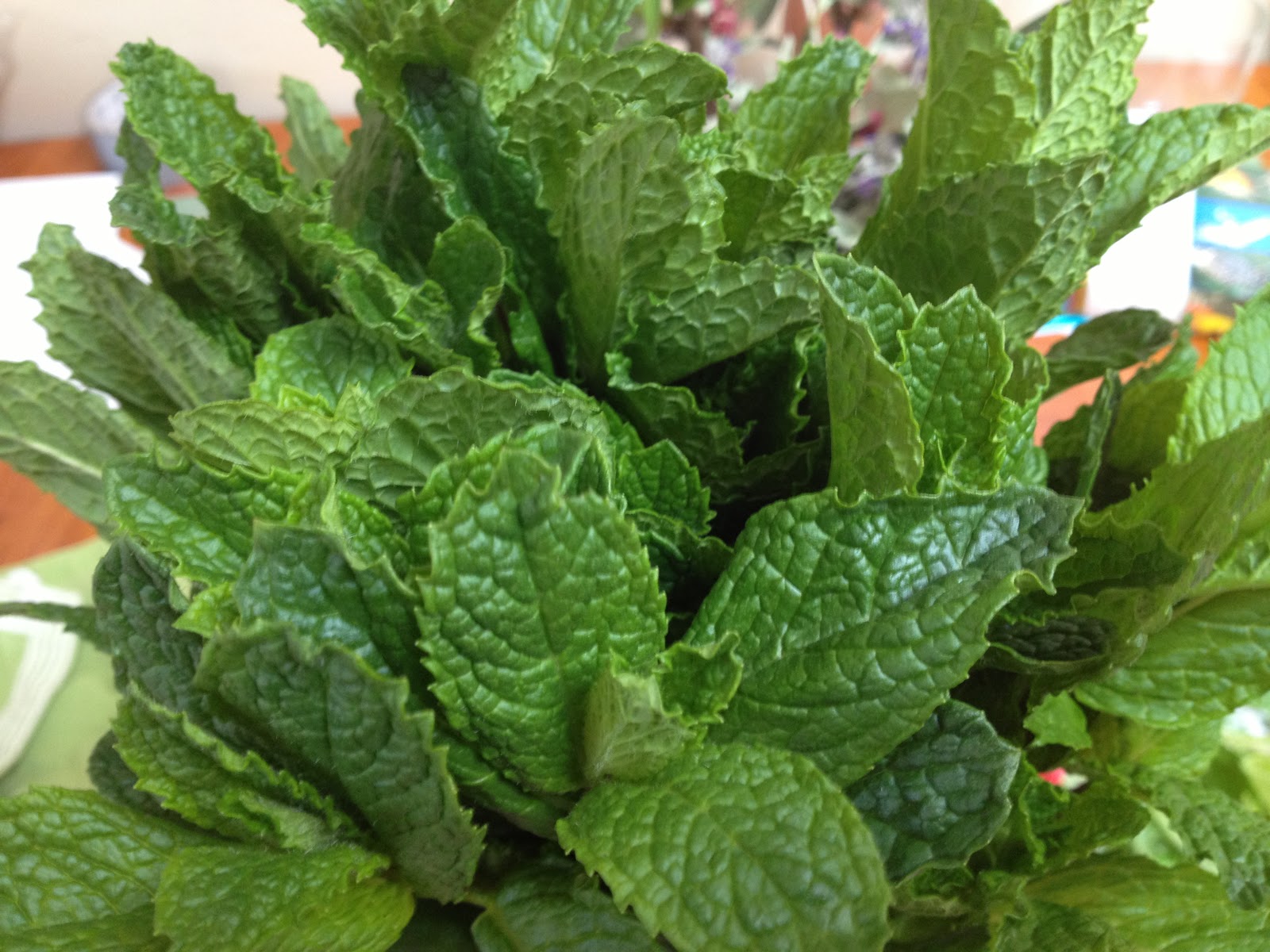
He also asked for mint, and I was so happy for an excuse to buy this beautiful bunch! The scent of this spearmint alone could send anyone into a food euphoria. When the baby was first eating solids I would blend some of this in with steamed green beans -- it was amazing. I got a surprisingly large bunch for just $1.50, so now I'll be looking for more ways to use this tantalizing herb. Any suggestions?

I'm delighted with these Persian cucumbers from Beylik Farms in Fillmore. I asked the farmer how they deal with pest control, and his happy answer was: beneficial insects. "It's about the only way to get rid of them without using pesticides," he said. "For every harmful bug there's a beneficial one." He mentioned that they use varieties of wasps and mites, as well as ladybugs. 


I used to think that all I could find locally would be kale and chard and collard greens, but I've also found more standard vegetable staples at the market. I bought extra carrots this week: some for snacking, and some for juicing.


Last but not least, also from Underwood, these handsome artichokes. I often see artichokes at the store for $3.00 each, but these were $1.75 or 3 for $5.00 -- so if you still think that fresh and sustainable food always costs more, perish the thought. We'll enjoy these with some steaks I bought at the Ventura Meat Company.  

Not pictured: farm fresh eggs and fresh cheese curd.


I’m getting better at planning my meals and shopping around the market. For the last couple of weeks I’ve spent roughly equal amounts at the farmer’s market, the Meat Company, and the grocery store. (My grocery store list has shrunk down to basically milk and other beverages, cereal and baking goods, a few shelf items like chili or peanut butter, and yes, bananas grown in Peru. The baby and I both love them, and they’re one of the few things that aren’t grown much around here.)

How important is it to you to eat locally? What items are hard to find in your area, and what do you do about it? 

Wednesday, February 27, 2013

Are There GMOs in my Bread? Monsanto, Prop 37, and Your Kid's Sandwich


Recently a friend asked on Facebook for recommendations for finding GMO-free bread. My first thought was to ask the bakeries at my farmers market – today I did, and I was not disappointed. The woman at the first stand didn’t know if their wheat was GM, but said she would find out and be ready to tell me next week (and she sold me a loaf of tangy local sourdough). The knowledgeable baker from the Thousand Oaks Great Harvest Bread Co. sold me some tasty dinner rolls, and pointed my GMO search in the right direction: www.gmo-compass.org.

Wheat, it turns out, is not currently cultivated in any genetically modified forms. That’s good news! However, GM wheat has been tried, and will almost certainly be tried again. Monsanto began pursuing a genetically modified wheat in 2002 but dropped their efforts in 2004, in part because wheat is a big export product and the markets in Europe in Asia are “more skeptical” of GMOs, according to the site. Scientists are currently researching ways to use genetic modification to make wheat more resistant to fungal infections that affect the crop world wide.


What's in your bread?
So are there GMOs in my bread? Not in the wheat, but as my neighborhood baker pointed out, he couldn’t vouch for the corn or soy in some of his multi-grain breads. Even if the farms where they source their grain use non-GMO cultivars, pollen from modified plants can easily contaminate the crop, making it extremely difficult to guarantee a GMO-free product. Trying to keep GM and non-GM strains separate has resulted in frustration and law suits, including one before the Supreme Court last week. Indiana farmer Vernon Bowman unwittingly planted grain contaminated with a patent-protected GM variety of soybeans, and Monsanto sued him for using their technology without paying for it – essentially for stealing GM technology that was more or less foisted upon him.

Like a true tragedy, this story ends in the awful way we knew it would. In a write up on the Huffington Post, Eric Holt Gimenez, executive director of Food First/Institute for Food & Development Policy, says “It is painful to read the transcripts." He goes on: “The problem before the U.S. Supreme Court in Bowman v. Monsanto was not the cost-cutting strategies of a 75-year-old farmer. The problem was the law itself.”

Coincidentally (or not), when I got home from the market today I found an e-mail from a local group trying to raise awareness and promote policy change regarding the use and labeling of GMOs in our food. (Find them on Facebook as Label GMOs Ventura County.) They started as a group promoting California’s Proposition 37, requiring the labeling of GMO ingredients in food, which narrowly lost.

The fact that the margin was so narrow, less than 1% statewide, is remarkable considering the gap in funding between the pro and con sides. What’s not so remarkable: the top three funders for No on 37 were Monsanto, DuPont, and Pepsico. 

Now the Ventura group is trying to turn things around and rejoin the battle. No California legislators will agree to author a bill requiring GMO labeling, so activists are once again working on a ballet initiative, with hopes of getting it in front of voters in 2014. If you are interested in information or helping out with this group, you can contact them at labelgmoventura@gmail.org, check their Facebook page, or attend a strategy meeting on Sunday, March 10, 3 p.m. at the Clubhouse at Mira Vista Complex, 2760 E. Ponderosa Dr. in Camarillo.

Friday, February 8, 2013

Farmers Market 2.0


"When food is cheap," writes Deborah Madison in the introduction to Local Flavors: Cooking and Eating from America's Farmers Markets, "we tend to treat it carelessly and wastefully. But when it's dear, when it costs what it's actually worth, we tend to pay closer attention to it. In this sense, good food can sharply focus our world."

Sweet carrots and green beans from Wednesday's market
Perhaps, like me, you're working on a New Year's resolution to get your world in sharper focus by eating intentionally. Grocery store food is relatively cheap and relatively convenient, but that's about all it has going on. It has diversity, which is a boon in more wintery states, but here in the land of eternal spring it doesn't even have that edge -- there are avocados growing on the street where I live, and bananas a few miles away, so why eat ones from Mexico or Hawaii that have traveled thousands of miles to reach my table?

Eating sustainably grown food from my region benefits my body and my family, my community and local economy, and, not least of all, the land that I love. But there are so many routes to choose and considerations to balance -- how can I eat locally and keep it simple?

One way, of course, is the farmers market. Pro: you can chat with the farmer, and enjoy sampling and picking through a variety of stands. There are often flowers and finished goods, too, like fresh cheese, beeswax candles, and, at my local market, grass-fed beef and delicious tamales. Con: you never know what's going to be available, you need cash, and you have to arrange your meal plans and your schedule around when the market is open. And weirdly, at my market, only half or fewer of the farms represented are organic or sustainable.

Another fantastic way is the CSA, or Community Supported Agriculture. Essentially you buy a share, or a subscription to a farm, and they provide you with a box of produce each week. It's wonderful for the farmer, as it provides a more stable market, and you share the risk she takes if the weather turns bad or a crop fails. There are also pros for you: a box of seasonal produce each week, a close relationship with a farm, and usually discounted prices. You might get to try some new-to-you varieties, and the farmer can provide recipes. Cons: you usually have little choice in what you get. My experience happened to entail a lot of greens, some other greens, and some more greens. I barely know what to do with any greens, much less a fridge full, so unfortunately a lot of my beautiful and virtuous produce went in the compost bin.

A new route has recently been gaining in popularity that seems to keep a lot of these pros and diminish the cons -- the regional farm delivery service. I'm getting to be a big fan of my local company, Farmer Fresh to You, started by two women formerly in the restaurant industry who understand the desire to combine eating locally with more choice and convenience. They provide a box of seasonal produce each week, chosen from organic and sustainable farms all over my region, and deliver it to my door.

Pro: they create a standard box with seasonal selections each week, but I can go online and customize my order with whatever other fruits and vegetables are available. ("I wouldn't care for chard, let's try summer squash!") I can also add eggs, bread, olive oil, and any number of other goods from local farms and artisans. I buy the box each week rather than monthly, so I can stop if I'm on vacation, or tailor what size box I want each time. Delivered to my door is nice, too!

Con: Compared to the subscription model of a CSA, ordering weekly seems to diminish the value to the farmer -- that is, a guaranteed income and market for his goods. But perhaps it is no more volatile than the farmers market. Having the box delivered to me seems like an unnecessarily luxurious use of fuel. But perhaps it is no worse than me driving to the market, or to a farm to pick up my weekly share.
My box this week: celery, fingerling potatoes, green beans, mushrooms,
raspberries, tangerines, kiwi, green onions, carrots, and dinosaur kale

For now, this is the route I'm choosing. My box arrived this morning. What is in season right now on the central coast? Everything! Hope Little One will enjoy kiwi fruit.

I'm food rich, and happy to be supporting both local farmers and some clever entrepreneurial women, but I have my doubts about this being the best way. What do you think?